Featured

LIPA CITY

Two things are infinite: the universe and human stupidity; and I'm not sure about the universe.-Albert Einstein

Lipa, officially the City of Lipa, (Tagalog: Lungsod ngLipa), or simply known as Lipa City, is a 1st class cityin the province of Batangas, Philippines. According to the 2015 census, it has a population of 332,386 people. It is one of the three cities in Batangas aside fromBatangas City and Tanauan.

17716000876_0f2dffa9b7

SM Lipa

download

SM Prime Holdings, Inc. or SM Prime is the parent company of the SM Group’s shopping malls. It is the largest shopping mall and retail operator in the Philippines.


Lipa Cathedral

Metropolitan Cathedral of San Sebastian
Katedral ng Lipa
Catedral Metropolitana de San Sebastián
Lipa Cathedral.JPG

Facade of Lipa Cathedral

Lipa Cathedral is located in Philippines

Lipa Cathedral
Lipa Cathedral
Location in the Philippines
13°56′27″N 121°09′48″ECoordinates13°56′27″N 121°09′48″E
Location Lipa, Batangas
Country Philippines
Denomination Roman Catholic
History
Status Parish Church
Dedication Saint Sebastian
Architecture
Functional status Active
Architectural type Church building
Style Romanesque
Administration
Archdiocese Lipa
Clergy
Archbishop Gilbert Garcera
Priest in charge Rev. Fr. Cecilio M. Arce
Assistant priest(s) Rev. Fr. Bartolome E. Villafranca
Rev. Fr. Emmanuel M. Vergara
Rev. Fr. Jessie A. Pentinio

The Metropolitan Cathedral of Saint Sebastian, commonly known as the Lipa Cathedral, is a Romanesque church in Lipa, BatangasPhilippines. The cathedral serves as the seat of the Archdiocese of Lipa. The Cathedral was chosen as the seat of the then Diocese of the Lipa in 1910. Detached from the Archdiocese of Manila and canonically erected by Pope St. Pius X, it comprised what are today the provinces of BatangasQuezonAuroraLagunaMarinduqueOccidental MindoroOriental Mindoro, and part of the Camarines area.

Villa Escudero
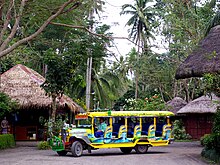
The jeepney takes tourists around the Villa Escudero grounds in San Pablo CityLagunaPhilippines

Villa Escudero Plantations is 800 hectares (2,000 acres) of working coconut plantation and hacienda located 10 kilometres (6.2 mi) south of the city of San PabloLaguna Province on the border with Quezon Province in the Philippines.[1] Since 1981, the plantation has opened its doors as a resort offering village tours, museum tour, food and accommodations. It has developed a worldwide reputation as a focal point to experience Philippine culture and history in a beautiful rural setting.

Malepunyo Mountain Range

The Malepunyo Range is an inactive volcano to which its caldera is facing south along the vicinity between Lipa City and San Antonio, Quezon. By the 1990s the Malepunyo Mountain Range has been erroneously tagged as Malarayat Mountain Range due to the famous country club located at its western slope named after the Malarayat Hill. Mount Malepunyo is its highest peak located at Barangay Talisay, Lipa City standing at 1,002 metres (3,287 ft) above mean sea level by the ridge of its caldera. The second highest peak of the range is Mt. Dalaga standing at 755 metres (2,477 ft) above mean sea level situated at the boundary of Santo Tomas, Batangas and Alaminos, Laguna. During the 1990s, the name was changed by the locals of Santo Tomas to Manabu as a shortened Tagalog phrase Mataas na Bundok which means “High Mountain”. At the center of the mountain range is a cliff known as Bagwis Cliff by the locals, yet due to its shape that resembles a goat’s breast, it is also called as Susong-Kambing (en:Goat’s Breast). In time, mountaineers have also mistakenly named this cliff as Susong Dalaga (en. maiden’s breast) which is actually the oldest name of Manabu Peak. A discontinued highway project connecting San Pablo City and Lipa City that traverses the central part of the mountain range made way for the creation of what the mountaineers call as Biak na Bundok (en. Sliced Mountain)

Thanks for visiting my page! I hope you enjoy watching my site.

← Back

Thank you for your response. ✨


Tell Tale Heart

1.) What is the meaning of The Tell Tale Heart?

==The Tell Tale Heart is a short story by American writer Edgar Allan Poe, first published in 1843. It is relayed by an unnamed narrator who endeavors to convince the reader of his sanity while simultaneously describing a murder he committed.

2.) What is the symbolism of the story?

==The Eye – There are many symbolic interpretations of the old man’s eye: (1) The eye represents the “I”; that is, it represents the essence of the old man; (2) The eye holds mysterious powers, according to the narrator, and may symbolize the inability of the narrator to hide his secret sins; (3) The old man’s eye is “pale blue, with a film over it,” indicating a lack of visual clarity and reliability. In this sense the eye symbolizes the narrator in so much as all the information we receive comes through his distorted mind, much in the same way everything the old man sees is filtered through his distorted eye

==The Old Man’s Bedroom – The narrator’s intrusion into the old man’s bedroom violates honorable conduct (especially when you take into account the whole murder thing). Speaking of violating someone, take a look at how the narrator describes his entrance into the room: “When I had made an opening sufficient for my head…I thrust in my head. Oh you would have laughed to see how cunningly I thrust it in! I moved it slowly–very, very slowly” (173). The narrator recounts on the eighth night,

3.) What is the mode and tone of the story?

==The narrator’s tone is arrogant and excited. He is excitable because he is mentally unstable. Yet he is arrogant enough to believe he is right. The narrator in “The Tell-tale Heart” is an unreliable narrator.  We realize from his tone that he is mad.  The narrator is obsessive and paranoid. He describes the killing of his roommate and the consequences in a matter-of-fact way, but in a very excited way.


4.) What is the conflict, climax, and resolution of the Tell-Tale Heart?

==The exposition of the “Tell-Tale Heart” is when we are introduced to the narrator and he insists that he is not insane. The rising action takes place as the narrator tries to muster the courage to kill the old man. The climax of the story is when the narrator kills the old man. The falling action of the story occurs when the narrator “hears” the beating of the old man’s heart beneath the floor boards.

The rising action of the story occurs when there is some kind of obstacle standing in the way of the outcome of the story. Here the rising action occurs when the narrator goes into the old man’s room for seven nights. He wants to kill the man, because he thinks his blue hazy eye can see the inside of the narrator. Each night when he goes to kill the man, the man’s eye is open, making the narrator think the old man is watching him.

The climax of a story is usually the most intense part of the story. Here the climax occurs when the narrator kills the old man. He thinks that once he has killed him the old man will not be able to see him anymore.

The falling action of a story comes right after the climax. The falling action ties everything up and ends the story. Here the falling action occurs when the narrator “hears” the old man’s heart beating, although he has just killed him. The police are talking to the narrator, and he hears the beating of the dead man’s heart getting louder and louder. The narrator finally admits to what he has done and tells the police to tear up the floorboards to find the “beating heart”

5.)What is the moral lesson the story?

==The moral of “The Tell-Tale Heart” is that we should not commit crimes because, in the end, our own sense of guilt will expose us.

6.) Who is Edgar Allan Poe?

==Edgar Allan Poe (January 19, 1809 to October 7, 1849) was an American writer, poet, critic and editor best known for evocative short stories and poems that captured the imagination and interest of readers around the world. His imaginative storytelling and tales of mystery and horror gave birth to the modern detective story. Many of Poe’s works, including “The Tell-Tale Heart” and “The Fall of the House of Usher,” became literary classics. Some aspects of Poe’s life, like his literature, is shrouded in mystery, and the lines between fact and fiction have been blurred substantially since his death.

I am Diversity Please Include Me

download

Today, we hear the words Cultural diversity in the work place, in communities, in places of worship. Statistics tell us that the balance of ethnicity and culture is changing in the world, and we shall be living in a very different socio-ethnic place in another 10 years. The secret to a peaceful existence and a productive work environment is to embrace the effects of cultural diversity, and welcome the creativity it brings.

The foundation for an inclusive culture must embrace certain fundamental understandings.

We need to recognize that Laws are different around the world;

Laws govern and /or dictate behaviors between people.

Our Beliefs are opinions and convictions that act as a filter through which we see the world.

Religious beliefs and customs, together with cultural morals create boundaries for our standards of behavior. These become the boundaries of what is, and what is notacceptable. Together they form a Compass for complex decision making.

By learning about cultural diversity, we develop knowledge and understanding of different groups of people, helping us to enrich our lives and break down barriers of prejudice and suspicion.

“Cultural differences should not separate us from each other, but rather cultural diversity brings a collective strength that can benefit all of humanity.” — Robert Alan (American writer, artist and social activist; 1922-1978)

In the preface to my Poetry book, The Moon of Compassion I explain that my Poems are designed to raise awareness, and focus on issues that must change in order to achieve a free and enlightened world.

My hope is that by reading these simple poems, that buck against socially and culturally intense subjects , I might spark discussion and inspire thought. Despite emphasis on cultural awareness and sensitivity in the Western world, Women are still under-empowered, and under-valued .  In many cultures they are oppressed and abuse is rife. In my audio book, the combination of visual illustrations and the option to listen to my own rendition, offers a different perspective and use for poetry in the field of social studies and education.

              Early history says that the first settlers of the city were war-like descendants of the two Bornean Datus Dumangsil and Balikasusa between the 10th and 13th century AD.It is said that the early Lipeños were Buddhist in religion and Indian in civilization while influences coming from other races also became inevitable due to the not so infrequent contacts with traders and merchants coming from China. With the Spanish conquest of the region, the Lipeños were also forced to embrace the Hispanic Christian culture of the West. This is the reason why they say that in Lipa, “the East also meets the West.” Lipa City is one of the three cities in the province of Batangas, Philippines. (Tanauan City, Batangas City). It is located 78 Km away from Manila, (Philippines Capital City) and approximately one and a half hour ride. The city is named after a tree called “Dendrocnide meyeniana” or Lipa Tree. A recreational city that attracts tourist because of its nice weather, beautiful places, religious, commercial, industrial and educational center. Lipa City is also known for having nicknames like Next Wave City, Little Rome of the Philippines, City of All Seasons.

Lipa is also called Little Rome of the Philippines. We all know that Rome in Italy is a predominantly Roman Catholic population and home of the Holy Pope.  Lipa City is called Little Rome of the Philippines because of churches and religious groups 99.5% of the city population are Roman Catholic there are 49 parishes in all and 23 existing catholic schools, two high school seminaries, three college seminaries, and two pastoral centers. Have time to visit Carmel Monastery, Lipa San Sebastian Cathedral,Redemtorist Lipa and Parish of Mary Mediatrix of All Grace.Lipa City is a pilgrim’s paradise and an ideal tourist destination. Many years back, the City has welcomed busloads of people who are mostly pilgrims. Almost always, they visit the Carmelite Monastery Chapel, the site of the 1948 apparition of Mary Mediatrix of All Graceyou. Here in Lipa you can enjoy “church-hopping” and attend mass with the whole family. Then, go on a foodtrip with your friends at the night market. But in some reason nightmarket here in LIpa has been demolished.

Here in Lipa the elders saying is “Dine sa Lipa, eh iba talaga… basta kapag nakapunta ka dine,, ay imposibleng di ka babalik,, babalik at babalik ka parin,” because here in Lipa there is many places that you can go. Also the foods and people in Lipa are very kind and hospitable. Lipa, unlike many of the famous tourist spots in the Philippines, can actually be considered to be a sleeper sight. By sleeper sight, I mean that it has enough attractions and sights to visit to actually warrant an unforgettable experience. There are tons of things to do and see in Lipa, you only have to experience it. Different resorts, places of interest, and establishments filled with histories for you to uncover. Lipa is a city wherein culture and history are cultivated to create a unique blend of a story. For that reason, many foreigner come back to taste again the food and meet many different people. I realize that I must treasure all things that I have because I’m from Lipa. And the thing in LIpa is very special unlike any other city here in Batangas.


Continue reading